
Practical Organization Guide · 4 min read
How to write down where things are, without writing down passwords
A safe, practical way to create a household 'pointer map' for keys, folders, and utility companies while keeping private numbers completely off the page.
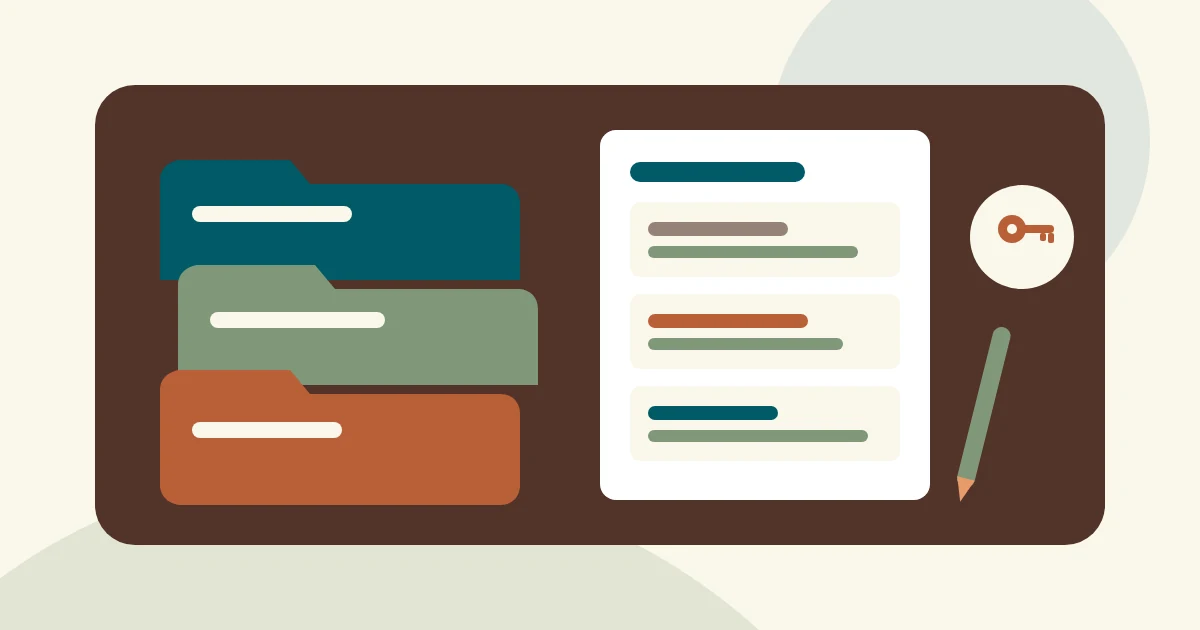
Every household has its own quiet memory system. In most homes, one person knows that the spare back-door key hangs on a brass hook inside the broom closet, the appliance instruction booklets sit in a shoebox on the laundry shelf, and the town water bill arrives every three months in a blue envelope.
When an adult son or daughter steps in to help with errands or look after the house for a week, not knowing where everyday things are kept leads to hours of opening drawers and guessing. At the same time, both parents and adult children rightly worry about safety and scams. You should never write passwords, PINs, or account numbers on a sheet of paper sitting out in the house.
The safest, calmest way to solve this is to make a household pointer map instead. A pointer map tells a trusted family member where to look and which company provides a service, while leaving all secret numbers completely off the page.
1. Use the "Pointer Rule" on every single line
Think of your printed organizer sheet as a signpost in a library, not a locked safe. Whenever you and your parent fill in a line together, write down only two simple facts:
- What the item or service is (for example, "Spare Car Key" or "Electric Company")
- Where the physical item or paper folder is kept in the house (for example, "Small ceramic dish on top pantry shelf" or "Den filing cabinet, top drawer, green folder")
Imagine what happens if a repair person, a visitor, or a stranger ever glances at that page. All they would learn is that your parent gets electricity from the local utility company and keeps file folders in the den. They would see zero account numbers, zero passwords, and zero personal identification numbers.
2. Start with keys, switches, and everyday house routines
When you ask an aging parent to sit down and organize household records, starting with file drawers can feel overwhelming or intrusive. Start with the physical house instead. Pour two cups of tea, clip a sheet to a clipboard, and ask about the practical things you would need if you were house-sitting for a weekend:
- Where the spare keys for the front door, back door, mailbox, garage, and car are kept
- Where the main water shut-off valve, electrical breaker box, and thermostat manuals live
- Which day of the week trash and recycling bins go out to the curb
- Which local plumber, electrician, heating company, or handyman your parent trusts and likes to call
Filling in these everyday house pointers takes about fifteen minutes. It feels natural, helpful, and conversational because you are simply learning how the house runs.
3. Group loose papers into three plain colored folders
Instead of copying long reference numbers off paper bills onto your worksheet, let the original bills do the work inside their own folders. Buy three or four sturdy colored file folders and label the tabs in large, dark marker:
- Green Folder — Home & Utilities: Recent statements for electricity, heating, water, trash, telephone, internet, and yard services.
- Blue Folder — Vehicles & Appliances: Car registration receipt, local mechanic receipts, and manuals for the furnace, water heater, and kitchen appliances.
- Yellow Folder — Household Contacts & Schedules: Printed phone lists, neighbor contact cards, and community center calendars.
Put those folders into one drawer or one desktop file box. Then, on your Where-Everything-Is sheet, you simply write: "Heating service statements: Green folder in hallway desk." When you need the customer service phone number on a snowy evening, you walk straight to the green folder.
4. Keep a strict list of what NEVER goes on paper
To keep your parent and your family protected, follow a clear rule across every printed sheet in your binder. Never ask for or write down:
- Computer, email, phone, or website passwords and passcodes
- Bank account numbers, routing numbers, or credit and debit card numbers
- Social Security numbers, government ID numbers, or ATM PIN codes
We print a clear reminder right on our organizer pages so everyone in the family remembers this boundary. By writing down only physical locations, folder colors, and company names, your family gets the peace of mind of knowing where everything is without ever putting private numbers at risk.